
 English
 عربى
 Español
 Deutsch
Energy Absorbers in Work at Height: What Decides Lanyard Choice

Jinhua JECH Tools Co., Ltd. has specialized in personal protective equipment for high-altitude work for 16 years. As a national standard drafting organization, the company operates a professional product testing center certified to ISO/IEC 17025 (CNAS L20086).
Energy Absorbers sit quietly on a crew member's belt for hours, then do their whole job in a few seconds. Picture a crew member stepping along a scaffold platform six metres above the ground, tool bag on one side, harness clipped to a lanyard on the other. Nothing about the moment looks tense. The equipment's task is to spread the force of a fall across enough distance to keep it manageable, and the way that task is specified shapes how a whole range of lanyards is chosen.
What the Absorber Pack Does in a Fall
Inside many Energy Absorbers sits a folded length of webbing, stitched into a compact pack under a cover. In normal movement it stays closed. When a fall loads the lanyard, the stitching releases in stages and the webbing pays out, so the stopping force builds over a distance instead of arriving as a single jerk at the harness.
That trade of force for distance is the whole idea behind Energy Absorbers. A single Energy Absorber Lanyard from the JECH range, for example, is designed to dissipate the energy of a fall of up to 4 m and to keep the force on the body to no more than 6 kN. Those two figures describe the job well: a defined drop, and a defined limit on what reaches the person. Distributors reading a product list can use them as a quick way to compare one Shock Absorber Lanyard with another.
Clearance Under the Work Area
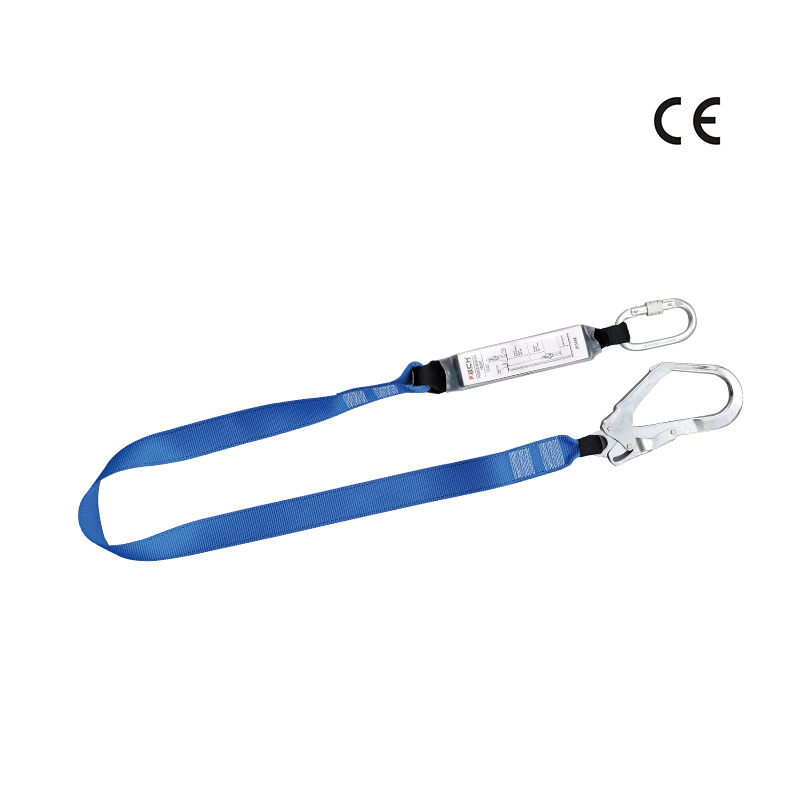
The distance that makes Energy Absorbers work also takes up space. A lanyard is useful when the worker stays clear of the ground or a lower platform once the pack has opened, so planners add up the lanyard length, the opened absorber, the stretch of the harness and a margin below the feet. On low scaffolds this sum decides which lanyard suits the job; on tall steel structures it matters less.
Adjustable styles help here. A lanyard with a rope adjuster lets the user shorten the connection to suit the working position, which keeps the distance to the anchor short and the clearance requirement smaller. Elastic versions suit crews who move along a structure and need the lanyard to follow without dragging. Each of these lengths and styles appears in order sheets, which is why length options belong on the product list from the start.
Hook Styles Follow the Structure
Work sites differ in what the hook has to grab. Scaffold tubes call for a large gate opening, and a forged Scaffold Hook handles this task on tube-and-coupler frames. Steel beams, ladder rungs and rebar each suit a different hook size, so lanyard ranges tend to include several styles on the same absorber pack.
Material shapes the choice as well. Webbing lanyards are flat and light, and they sit comfortably alongside a Safety Harness on long shifts. Rope versions suit rough edges and frequent contact with structure. Jinhua JECH Tools lists forged big-hook, webbing, adjustable and rope-adjuster versions of its single absorber lanyard, so a distributor can cover scaffold, tower and steel-frame work from one product family.
Putting Lanyards Into Order Sheets
Contractors rarely buy a lanyard alone. Orders arrive as a harness and lanyard pair, sometimes with a hook change, a colour request or a branded label. A distributor who stocks one set of Energy Absorbers with three hook options and two lengths covers more job types than one who stocks a single fixed style, and the factory can customise length, webbing colour and marking when the quantity supports it.
Compatibility between harness D-ring and hook is worth confirming before a sample goes out, since a hook that opens wide on a scaffold may be too large for a smaller attachment point. A short note on the order sheet, naming the site type and the harness model, lets the factory suggest the matching lanyard from the start. Lists that carry Energy Absorbers in several lengths and hook styles tend to be reordered in mixed lots, because crews on different structures each find the style that fits their site.
Your email address will not be published. Required fields are marked *

One-stop work at height solutions
Contact Us
- No.1448 Tongxi Road Linjiang Industrial Zone, Wucheng District, Jinhua city 321025, Zhejiang Province, China
- +86-579-82210589
- jech@jechsafety.com
Subscribe US
Stay updated with our latest news. We promise.