 English
 Heavy Duty Tie Down Rings Are Rated by Load, Not Size Alone
Jinhua JECH Tools Co., Ltd. has specialized in personal protective equipment for high-altitude work for 16 years. As a national standard drafting organization, the company operates a professional product testing center certified to ISO/IEC 17025 (CNAS L20086).
Buyers sourcing anchorage hardware for fall protection and cargo restraint applications have shifted how they evaluate connector rings over recent sourcing cycles, moving away from judging a ring purely on its visible thickness and toward requesting documented load ratings before placing an order. Heavy Duty Tie Down Rings that look nearly identical in size and shape can carry meaningfully different certified load capacities depending on the metal grade and forming process used, and buyers who skip this verification step are increasingly the exception rather than the norm. Suppliers report that requests for Heavy Duty Tie Down Rings with documented, batch-specific load data have grown noticeably compared to a few sourcing cycles ago.
Forged Construction Is Becoming the Buyer-Preferred Standard
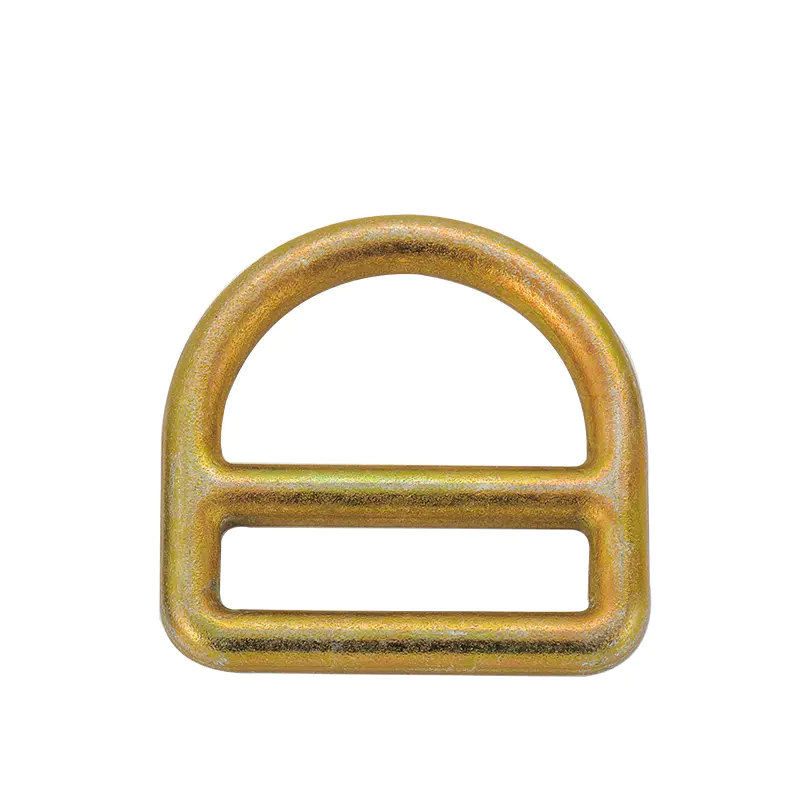
A steel D-ring connector produced through forging generally achieves higher load capacity than a stamped equivalent of similar visible dimensions, since forging aligns the metal's internal grain structure to resist fracture under load rather than leaving stress points that stamping from flat stock can introduce. Buyers sourcing Heavy Duty Tie Down Rings increasingly request forging method as a specific line item in sourcing conversations rather than assuming all rings marketed under a similar size designation share equivalent structural integrity. This shift reflects growing buyer awareness that visual similarity between a stamped and forged ring doesn't indicate comparable strength.
Documented Load Testing Is Replacing General Durability Claims
Buyers evaluating Heavy Duty Tie Down Rings now commonly request documentation showing the specific load a ring withstands without fracture, such as a rating around 22.2 kN, rather than accepting a general "heavy duty" or "high strength" description without a supporting figure. This trend parallels broader movement across the fall protection and rigging hardware industry toward quantified specifications buyers can compare directly across suppliers, rather than relying on marketing language that varies in meaning from one manufacturer to the next.
Comparing Ring Types Across Growing Application Categories for Heavy Duty Tie Down Rings
|
Ring Type |
Primary Material |
Typical Application Trend |
|
Steel D-Ring |
Carbon or alloy steel |
Heavy industrial and construction anchorage |
|
Aluminum D-Ring |
Aluminum alloy |
Weight-sensitive climbing and rope access |
|
Insulated D-Ring |
Steel with insulating coating |
Electrical and utility work environments |
|
Stamped D-Ring |
Flat steel stock |
Lower-load, cost-sensitive applications |
Buyers supplying electrical utility and telecom customers are increasingly specifying insulated variants as this application category grows, reflecting broader industry attention to electrical hazard mitigation in anchorage hardware selection.
Material Choice Is Splitting Along Weight-Versus-Strength Lines
An aluminum D-ring appeals to buyers supplying rope access and climbing markets where reducing total equipment weight matters directly to end users carrying gear over long work shifts, while steel remains the default for buyers prioritizing load capacity over weight savings. This split has become more pronounced as rope access and technical rigging markets grow as a distinct buyer segment for Heavy Duty Tie Down Rings, separate from traditional construction and industrial anchorage customers, each with different priorities driving material selection.
Certification Documentation Requests Have Grown More Specific
Buyers importing a load rated anchorage ring for regulated industrial use increasingly request certification documentation tied to the specific standard governing their application, whether that's general fall protection hardware certification or standards specific to rigging and tie-down equipment. Manufacturers running an in-house testing lab capable of validating load ratings for Heavy Duty Tie Down Rings against multiple certification frameworks are better positioned to serve buyers distributing into markets with varying regional standards than suppliers relying solely on a single certification pathway.
Customization and Bulk Supply for Growing Demand
Buyers placing bulk orders for a forged D-ring program spanning multiple sizes and finishes should confirm production capacity can support consistent load-rating documentation across every unit in a large order, not just a sample tested during initial qualification. Manufacturers running dedicated production across steel, aluminum, and insulated variants can typically accommodate mixed-material container orders, letting distributors stock a full range of connector hardware without committing full container volume to a single ring type as demand across these growing application categories continues to diversify.
Your email address will not be published. Required fields are marked *

One-stop work at height solutions
Contact Us
- No.1448 Tongxi Road Linjiang Industrial Zone, Wucheng District, Jinhua city 321025, Zhejiang Province, China
- +86-579-82210589
- jech@jechsafety.com
Subscribe US
Stay updated with our latest news. We promise.