 English
 What Should Buyers Verify Before Ordering Work Position Restraint Lanyards?

Jinhua JECH Tools Co., Ltd. has specialized in personal protective equipment for high-altitude work for 16 years. As a national standard drafting organization, the company operates a professional product testing center certified to ISO/IEC 17025 (CNAS L20086).
A distributor supplying tower maintenance crews often assumes that every restraint-style lanyard prevents a worker from reaching a leading edge, without checking whether the specific length and adjustment range actually match the work radius a customer needs. A Work Position Restraint Lanyard has to be sized and configured correctly for its intended application, and buyers who skip this verification tend to receive returns or complaints once a lanyard reaches the field and doesn't restrict movement the way the job actually requires.
Confirm the Product Prevents Free Fall, Not Just Restricts Movement
Before comparing suppliers, buyers should confirm that a Work Position Restraint Lanyard is designed specifically to make vertical free fall impossible, rather than simply limiting how far a worker can move before eventually reaching an edge. This distinction matters because a true restraint system keeps the worker's anchor point and lanyard length configured so they physically cannot reach a fall hazard, which is a different engineering requirement than a fall arrest lanyard designed to catch a worker after a fall has already begun. Buyers should ask suppliers directly which category a specific Work Position Restraint Lanyard product belongs to, since restraint and arrest systems serve different safety functions despite looking similar in a product photo.
Adjustability Range Should Match the Actual Work Radius
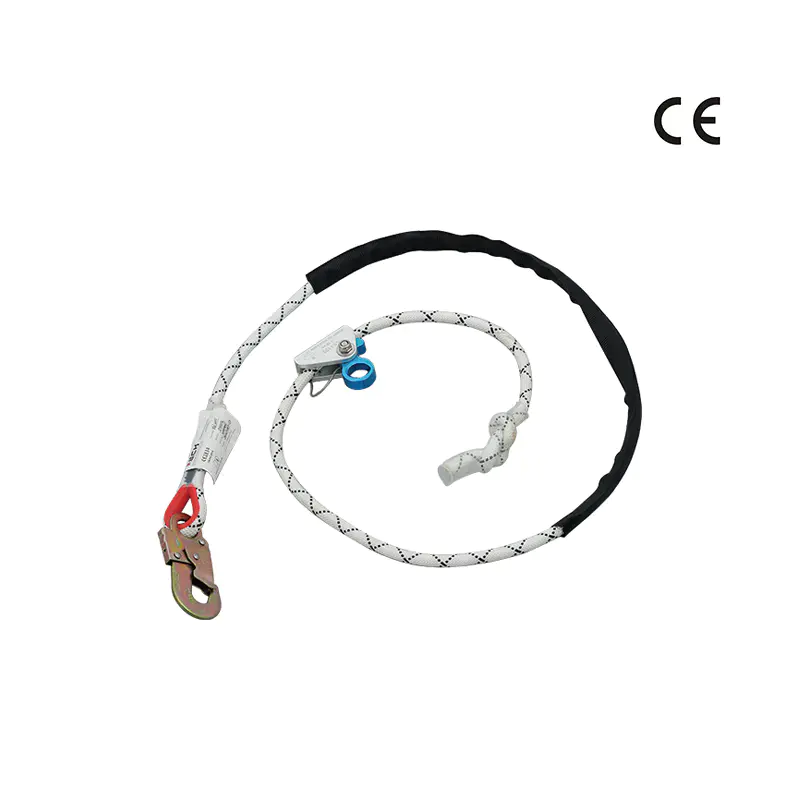
A rope grab lanyard or adjustable restraint system needs its adjustment range matched to the actual working radius a Work Position Restraint Lanyard customer's job requires, and buyers should request the specific minimum and maximum length figures rather than a general "adjustable" description. An adjustable restraint lanyard with too short a minimum length restricts a worker more than necessary, slowing task completion, while one with too long a maximum range can allow a worker to reach a hazard the restraint system was meant to prevent. Buyers supplying customers in inspection, maintenance, or oil production applications should confirm working radius requirements with the end customer before finalizing a lanyard length specification.
A Sourcing Checklist for a Work Position Restraint Lanyard
|
Sourcing Question |
Why It Matters |
|
Does the product prevent free fall or only limit movement? |
Confirms restraint versus arrest function |
|
What is the adjustable length range? |
Must match the actual work radius required |
|
What material is the webbing or rope constructed from? |
Affects durability and resistance to abrasion |
|
Is a rope grab or adjuster component included? |
Determines field adjustability without tool use |
|
What certification standard applies to this specific product? |
Confirms compliance for the destination market |
Material Construction Affects Durability in Repeated Use
A Work Position Restraint Lanyard built from twisted polyester rope resists abrasion differently than a webbing-based equivalent, and buyers should weigh this material choice against the actual working conditions their customers face. Rope-based restraint systems often provide better abrasion resistance against rough surfaces like concrete or metal edges, while webbing configurations may offer more consistent handling and coiling behavior for workers moving frequently between positions during a shift.
Certification Documentation Confirms Regulatory Fit
Buyers importing a fall restraint system for regulated industrial applications should request certification documentation confirming which specific standard the product meets, since restraint systems fall under different testing criteria than fall arrest equipment even when both are sold by the same supplier. A positioning lanyard supplier operating an in-house testing lab can typically provide certification documentation covering multiple regional standards from a single production line, which simplifies compliance verification for buyers distributing into more than one market.
Customization and Bulk Supply for Distributors
Buyers building a private-label restraint lanyard line should confirm whether a Work Position Restraint Lanyard supplier can accommodate custom lengths, rope-versus-webbing construction, and hardware configuration without requiring a new certification cycle for each variant. Manufacturers running dedicated production across multiple restraint lanyard configurations can typically batch mixed-SKU orders within a single container shipment, letting distributors stock a range of lengths and materials without committing full container volume to one specification.
Your email address will not be published. Required fields are marked *

One-stop work at height solutions
Contact Us
- No.1448 Tongxi Road Linjiang Industrial Zone, Wucheng District, Jinhua city 321025, Zhejiang Province, China
- +86-579-82210589
- jech@jechsafety.com
Subscribe US
Stay updated with our latest news. We promise.