 English
 Single Shock Absorber Lanyard Quality Starts With Stitch Tension
Jinhua JECH Tools Co., Ltd. has specialized in personal protective equipment for high-altitude work for 16 years. As a national standard drafting organization, the company operates a professional product testing center certified to ISO/IEC 17025 (CNAS L20086).
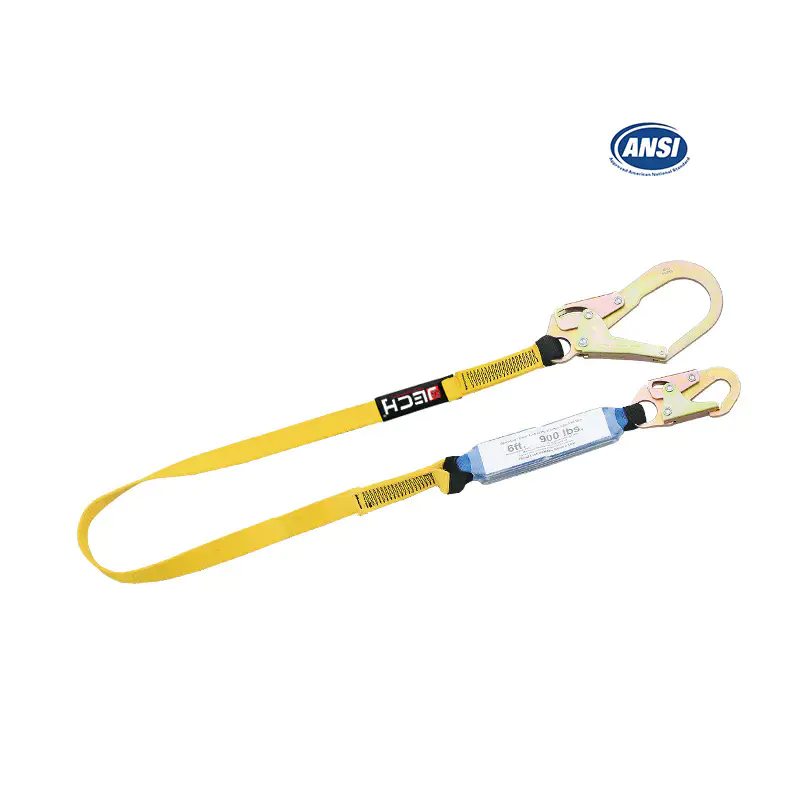
A lanyard that arrests a fall at 4kN in one test and 8kN in the next, despite carrying identical labeling, isn't a product buyers can rely on to protect workers consistently. Manufacturing a Single Shock Absorber Lanyard that performs within tight force limits batch after batch depends on how consistently the internal shock-absorbing component is constructed, not just on the webbing or hook hardware visible from the outside.
The Shock Absorber Component Has to Deploy Predictably
Inside a Single Shock Absorber Lanyard, a folded or torn-stitch webbing element is designed to progressively give way during a fall, converting kinetic energy into controlled deceleration rather than transmitting the full impact directly to the worker's body. An energy absorbing lanyard manufactured with inconsistent stitch tear-strength will deploy unpredictably, either releasing too easily and failing to control descent speed, or resisting too much and passing excessive force through to the harness and worker. Production lines building this component need to test stitch-tear force at regular intervals throughout a Single Shock Absorber Lanyard run, since thread tension and stitch density can drift as sewing equipment operates over an extended production shift.
Force Limiting Must Stay Within a Narrow Certified Range
A Single Shock Absorber Lanyard built to limit arrest force to 6kN needs manufacturing tolerance tight enough that every unit in a batch falls within that certified range, since a unit exceeding the limit risks injury even if the fall itself is successfully arrested. Manufacturing teams validate this through drop testing on sample units pulled from production batches, checking peak force readings against the certified limit rather than relying only on the initial design validation performed before mass production began.
Comparing Hook and Attachment Configurations
|
Attachment Configuration |
Typical Application |
Manufacturing Consideration |
|
Single Scaffold Hook |
Standard anchor point connection |
Hook gate strength testing |
|
Forged Big Hook |
Heavy-duty or high-clearance anchors |
Larger throat opening tolerance |
|
Rope Adjuster Integration |
Adjustable working length |
Adjuster friction consistency |
Buyers sourcing a Single Shock Absorber Lanyard for scaffolding and general construction typically specify standard hook configurations, while buyers supplying tower or heavy industrial applications often request forged big-hook variants for compatibility with larger anchor structures.
Webbing Width and Length Consistency Affects Deployment Behavior
A forged hook lanyard built around a webbing length of roughly 6 to 8 feet needs consistent webbing width and material weight across a production run, since variation in these specifications changes how the energy-absorbing element behaves under load even when the shock absorber component itself is built to identical specifications. Manufacturing teams should track webbing supplier lot numbers alongside finished product batches, since a shift in raw webbing material between lots can introduce performance variation that wouldn't be caught without lot-level traceability.
Certification and Quality Control for Export Production
A Single Shock Absorber Lanyard destined for European markets needs to satisfy the EU 2016/425 PPE regulation, while buyers supplying North American markets require ANSI compliance documentation covering the relevant fall protection standard. Manufacturers running an in-house testing lab can validate both certification pathways on the same production line, which matters for buyers distributing into multiple regions from a single supplier relationship rather than qualifying separate factories for each certification standard.
Customization and Bulk Supply for Distributors
Buyers building a private-label fall protection line should confirm whether a fall arrest lanyard program allows custom webbing color, hook type, and length adjustments without requiring a full re-certification cycle, since certification testing tied to a specific configuration can add meaningful cost if triggered unnecessarily by a minor customization request. Manufacturers running dedicated production across multiple hook and length configurations can typically accommodate mixed-SKU bulk orders, letting distributors stock a webbing shock absorber range spanning several configurations within a single container shipment rather than committing full volume to one specification.
Your email address will not be published. Required fields are marked *

One-stop work at height solutions
Contact Us
- No.1448 Tongxi Road Linjiang Industrial Zone, Wucheng District, Jinhua city 321025, Zhejiang Province, China
- +86-579-82210589
- jech@jechsafety.com
Subscribe US
Stay updated with our latest news. We promise.