 English
 Low Stretch Kernmantel Rope Manufacturing: Construction Standards
Jinhua JECH Tools Co., Ltd. has specialized in personal protective equipment for high-altitude work for 16 years. As a national standard drafting organization, the company operates a professional product testing center certified to ISO/IEC 17025 (CNAS L20086).
Procurement teams sourcing rope for aloft work often run into the same problem: a supplier quote lists "kernmantle rope" without specifying whether the product stretches under load. For rescue teams, riggers, and engineering crews working at height, that distinction is not cosmetic. A low stretch kernmantel rope is a static rope, built to behave differently from a dynamic climbing line, and understanding how it is manufactured helps buyers match the right product to the right application before placing an order.
Core and Sheath Construction
Every low stretch kernmantel rope relies on core-sheath construction: an inner core that carries the working load and an outer sheath that protects the core from abrasion, UV exposure, and dirt. The core is made of tightly braided nylon strands laid in parallel or twisted bundles, which limits elongation under tension. Unlike dynamic rope, where the core is engineered to stretch and absorb shock loads, the core of a static-type rope is constructed to stay close to its original length even when a worker's full weight is applied. The sheath is woven in a separate pass, using a tighter braid density on rope intended for repeated friction contact with edges, carabiners, or descenders.
Nylon Yarn Selection and Fiber Treatment
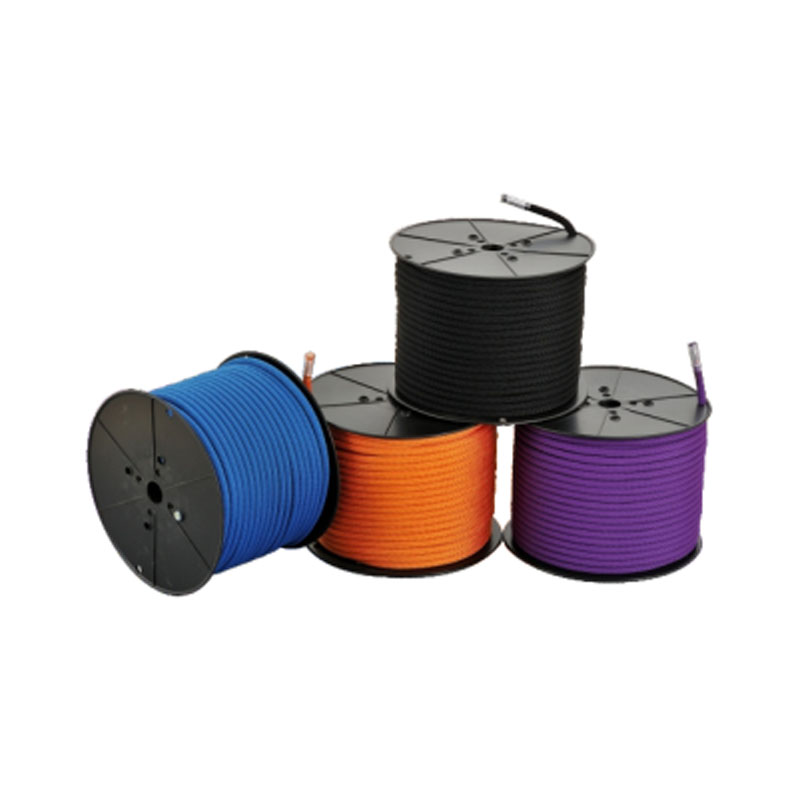
Material choice affects how a low stretch kernmantel rope performs across repeated use cycles. JECH sources nylon yarn rated for consistent tensile strength and applies a heat-setting process after braiding to stabilize the fiber structure and reduce shrinkage during washing or wet-weather use. This step matters for buyers whose crews perform work at height in variable humidity, since untreated nylon can absorb moisture and shift in diameter, affecting how the rope runs through hardware. The finished low stretch kernmantel rope also goes through a dye or natural-color run depending on whether the client requires a solid color for static-type identification on site.
Quality Control Before the Rope Leaves the Factory
Rope intended for climbing, rescue, or engineering work carries higher liability than general-purpose industrial cordage, so inspection cannot stop at a visual check. Diameter is measured at multiple points along each coil to confirm it stays within tolerance, since an undersized rope changes how it grips inside a descender or rope grab. Breaking strength samples are pulled from production batches and tested to destruction, and sheath slippage is checked to confirm the outer braid does not shift independently of the core under load. Buyers who request third-party lab verification alongside factory data typically receive a tighter picture of consistency across large orders.
Certification Under EN1891:1998
A low stretch kernmantel rope manufactured for the European market is produced and tested against EN1891:1998, the standard covering low-stretch rope used in rope access, rescue, and work-at-height applications. This standard sets requirements for static elongation, sheath slippage, and knotability, which is why static-type rope is typically supplied in a single solid color rather than the mixed patterns common on dynamic climbing rope — a visual cue that helps riggers avoid mixing rope types on the same job. Buyers exporting to other regions should confirm which national standard applies before finalizing specifications, since labeling requirements differ by market.
Static Rope vs. Dynamic Rope: Key Differences
|
Property |
Low Stretch Kernmantel Rope (Static-Type) |
Dynamic Kernmantel Rope |
|
Elongation under load |
Minimal, close to zero stretch |
Designed to stretch and absorb fall energy |
|
Typical use |
Rope access, rescue, aloft work, engineering |
Rock climbing, mountaineering, activities with fall risk |
|
Color pattern |
Usually solid, single color |
Usually mixed or patterned |
|
Core construction |
Braided for stability, not shock absorption |
Braided with built-in elasticity |
|
Reference standard |
EN1891:1998 |
EN 892 (dynamic rope standard) |
Diameter Range and Bulk Supply for B2B Buyers
The low stretch kernmantel rope covered here is produced at a 10.5mm diameter, a size commonly specified for rope access and rescue applications where handling and descender compatibility matter as much as strength. Length and color can be adjusted per order, and the rope is manufactured on the same production line as JECH's broader climbing gear range, which allows buyers combining rope with carabiners, rope grabs, or harnesses to consolidate sourcing. The factory runs daily output in the thousands of units, supporting order volumes from trial batches to full container loads, with each batch traceable to its production and inspection records for buyers who need documentation alongside the physical product.
Your email address will not be published. Required fields are marked *

One-stop work at height solutions
Contact Us
- No.1448 Tongxi Road Linjiang Industrial Zone, Wucheng District, Jinhua city 321025, Zhejiang Province, China
- +86-579-82210589
- jech@jechsafety.com
Subscribe US
Stay updated with our latest news. We promise.