 English
 Twin Shock Absorber Lanyard Keeps Workers Connected While Moving

Jinhua JECH Tools Co., Ltd. has specialized in personal protective equipment for high-altitude work for 16 years. As a national standard drafting organization, the company operates a professional product testing center certified to ISO/IEC 17025 (CNAS L20086).
A worker moving along a roof edge, a steel beam or a scaffold run has to unhook from one anchor point and reach for the next. During that short move, a single-leg lanyard leaves the worker attached to nothing. A Twin Shock Absorber Lanyard closes that gap by giving the worker two legs, so one hook stays on an anchor while the other moves.
Two legs, so one hook stays on the anchor
The product is a double lanyard with two scaffold hooks, used as a component of a personal fall arrest system to connect a safety harness to an anchor. The worker clips one hook onto the next anchor before releasing the previous one. A Twin Shock Absorber Lanyard therefore lets a worker keep a connection through every change of position, which is why many sites ask for twin legs on work that involves frequent repositioning, such as steel erection, facade work and scaffold climbing.
Scaffold hooks suit a Twin Shock Absorber Lanyard because they open wide enough to clip onto tubes and structural members, and a locking gate keeps the hook closed once it is on. The hook does the connecting, the absorber does the energy work, and the two parts have to be specified together.
What happens in a fall
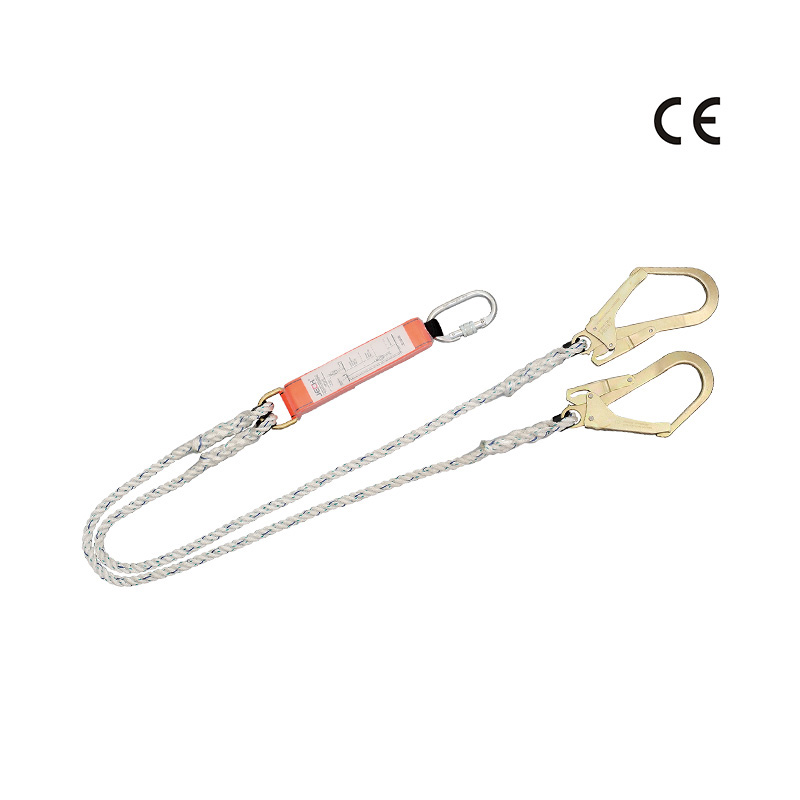
Each leg of a Twin Shock Absorber Lanyard carries its own shock absorber. In a fall, the leg that is loaded opens its absorber, which pulls out a folded, stitched webbing pack to take energy out of the fall. The other leg stays unused. The product description states the lanyard is designed to dissipate the energy developed in a fall of 4m maximum height and to limit the force on the user's body to a maximum of 6kN.
That force limit is the reason the absorber exists. Stopping a fall is only part of the job, since the sudden stop itself can injure a worker if the force reaches the body unchecked. A fall arrest lanyard built to a 6kN limit takes a share of that energy out before it reaches the harness and the worker.
Once a leg has arrested a fall, the Twin Shock Absorber Lanyard goes out of service. The absorber has done its work, and a pack that has opened cannot do it a second time. The unused leg is stored on the harness between moves so it does not trail behind the worker and snag on equipment.
Material choices across the twin range
The Twin Shock Absorber Lanyard range on the product page comes in several constructions. Webbing versions are flat and light, and damage shows up clearly during inspection. Kernmantle rope versions use a protected core inside a woven sheath, and the sheath takes the abrasion from edges and rough surfaces. Polyester versions suit outdoor work, since polyester holds up well to sun and moisture, and the range includes an adjustable polyester model for work positions that call for a different length. An elastic version is listed for ANSI markets, and its stretch helps keep the legs from dragging when the worker moves.
Buyers comparing these constructions are really choosing between how a fall arrest lanyard behaves in daily handling. A Twin Shock Absorber Lanyard used mainly on open steel will see different wear than one used on a concrete edge, so the right leg material follows the site.
Standards and the one-person rule
The product is personal protective equipment under the EU 2016/425 PPE regulation, and it is for one person only. It must not be loaded beyond its strength rating or used for any purpose other than the one it was designed for. A fall arrest lanyard is not a lifting sling or a tie-down, and a supplier that states this plainly on the product page is describing the limits correctly.
Jinhua JECH lists EN 354, EN 355 and ANSI Z359.13 among the standards its products have passed, together with the CE and CSA marks. Distributors should ask for the certificate that matches the exact model and the market it will be sold in, since a lanyard certified for one region does not carry that approval automatically into another.
Specifying a twin lanyard for a project
Buyers can set out the order in four lines: leg material, length, hook type and the standard the market requires. A Twin Shock Absorber Lanyard matched to those four details arrives ready for the site without a second round of questions.
Private label and custom orders can change webbing colour, labelling and packaging. The absorber construction and the hooks stay tied to the tested design, because those are the parts the certificate covers. A Twin Shock Absorber Lanyard supplied with its test documents, clear markings and a pack that protects the absorber gives a distributor a product that can be inspected, sold and used without guesswork.
Your email address will not be published. Required fields are marked *

One-stop work at height solutions
Contact Us
- No.1448 Tongxi Road Linjiang Industrial Zone, Wucheng District, Jinhua city 321025, Zhejiang Province, China
- +86-579-82210589
- jech@jechsafety.com
Subscribe US
Stay updated with our latest news. We promise.