
 English
  عربى
عربى  Español
  Deutsch
 Why Are Shock Absorber Safety Lanyards Important?

Jinhua JECH Tools Co., Ltd. has specialized in personal protective equipment for high-altitude work for 16 years. As a national standard drafting organization, the company operates a professional product testing center certified to ISO/IEC 17025 (CNAS L20086).
Working at height carries real risk. On construction sites, maintenance platforms, steel structures, and scaffolding systems, a fall can happen within seconds. Safety Lanyards are designed to connect a worker's harness to an anchor point, creating a controlled connection between the person and the structure.
A lanyard does not work alone. It must be used together with a harness when working at height. The harness distributes force across the body, while the lanyard manages the connection and, in many cases, absorbs energy during a fall. This combination reduces the impact transferred to the worker and the anchor structure.
From a factory perspective, the focus is on material strength, energy absorption design, and consistent stitching patterns. These details directly affect performance in real working conditions.
What Types of Safety Lanyards Fit Different Job Sites?
Different tasks require different configurations. Not every site uses the same type of Safety Lanyards.
At JECH, lanyards are produced from twisted polyester ropes, kernmantel ropes, and webbing materials. Each material serves a purpose:
- Twisted polyester rope lanyards are commonly used in general construction due to their durability and flexibility.
- Kernmantel rope lanyards offer a strong core with a protective sheath, suitable for demanding environments.
- Webbing lanyards provide a flat profile and are easy to handle in confined areas.
These lanyards are subdivided into several series:
- Single shock absorber lanyard
- Twin shock absorber lanyard
- Work position restraint lanyard
Choosing the right type depends on whether the worker needs fall arrest capability, continuous tie-off while moving, or positioning support during hands-free tasks.
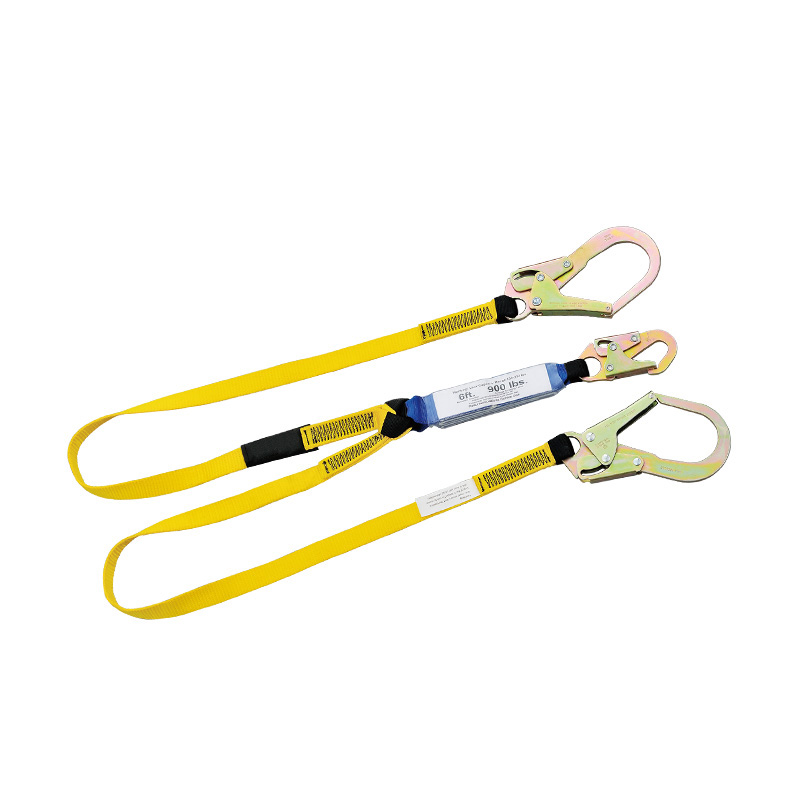
How Do Safety Lanyards Work with Harness Systems?
A lanyard alone does not provide fall protection. It must connect to a compatible harness. The harness distributes fall forces across the shoulders, thighs, and pelvis. The lanyard links the harness to a certified anchor point.
Work position restraint lanyards are used differently. Instead of arresting a fall, they limit movement to prevent reaching a fall hazard zone. These are often shorter and adjustable.
The correct pairing of the harness and Safety Lanyards depends on the task type. Fall arrest systems require shock absorption, while positioning systems focus on controlled restraint.
Are Wholesale Safety Lanyards Suitable for Large Projects?
Large infrastructure and industrial projects often require standardized equipment across multiple teams. Wholesale Safety Lanyards allow project managers to maintain consistency in rope type, shock absorber design, and connector specifications.
From a factory side, bulk production improves uniformity because materials are sourced in controlled batches and produced under the same technical parameters. This consistency supports predictable field performance.
For distributors and contractors, working directly with a manufacturer reduces variability between shipments and simplifies documentation management.
What Standards Should Safety Lanyards Meet for Compliance?
Compliance varies by region, but fall protection equipment typically follows recognized industrial standards such as EN or ANSI requirements. Testing generally includes static strength tests, dynamic drop tests, and hardware performance verification.
Manufacturers must maintain traceability of materials and conduct load testing during production. For buyers sourcing Wholesale Safety Lanyards, verifying factory testing procedures and documentation is part of responsible procurement.
JECH focuses on the controlled production of twisted rope, kernmantel rope, and webbing-based lanyards across single, twin, and positioning series. Consistent material selection and structured production methods support reliability in high-work environments.
Safety Lanyards play a central role in fall protection systems used across construction, utilities, and industrial maintenance. From material selection to shock absorber stitching design, each production detail affects real-world performance. Understanding application differences—single, twin, or positioning—helps match the right configuration to the right task while maintaining compatibility with harness systems.
Your email address will not be published. Required fields are marked *

One-stop work at height solutions
Contact Us
- No.1448 Tongxi Road Linjiang Industrial Zone, Wucheng District, Jinhua city 321025, Zhejiang Province, China
- +86-579-82210589
- jech@jechsafety.com
Subscribe US
Stay updated with our latest news. We promise.