 English
 عربى
 Español
 Deutsch
Anchor Devices on Steel Frames and Irregular Structures

Jinhua JECH Tools Co., Ltd. has specialized in personal protective equipment for high-altitude work for 16 years. As a national standard drafting organization, the company operates a professional product testing center certified to ISO/IEC 17025 (CNAS L20086).
Anchor Devices are the one link in a fall protection chain that attaches to something the equipment maker did not design: the structure itself. A Safety Harness and a lanyard arrive with known dimensions, while a steel beam, a round column, or a parapet arrives with whatever shape the project gave it. That gap explains why connector ranges are built around structures rather than around a single clip.
Three Surfaces, Three Answers
Anchor Devices sort themselves by surface. Flat members such as I-beams take an anchor strap that wraps the flange and closes on itself. Rounded or irregular shapes, such as pipe columns and lattice members, suit a rope connector, which bends to the profile where a flat strap would sit loosely. Where the structure already carries a built-in attachment point, a fixed Anchor Point Lanyard connects straight to it and gives the harness a defined place to clip.
Corners decide more than width does. A strap that turns around a square flange meets an edge that a round column does not present, so edge protection belongs in the same conversation as strap length. Jinhua JECH Tools lists anchorage strap connectors, anchorage rope connectors and a Fall Arrest Anchor Strap side by side, a grouping that mirrors how work sites divide between beams, columns and fixed points. A range of Anchor Devices built this way covers a warehouse roof with steel purlins as readily as a lattice mast.
How the Load Travels
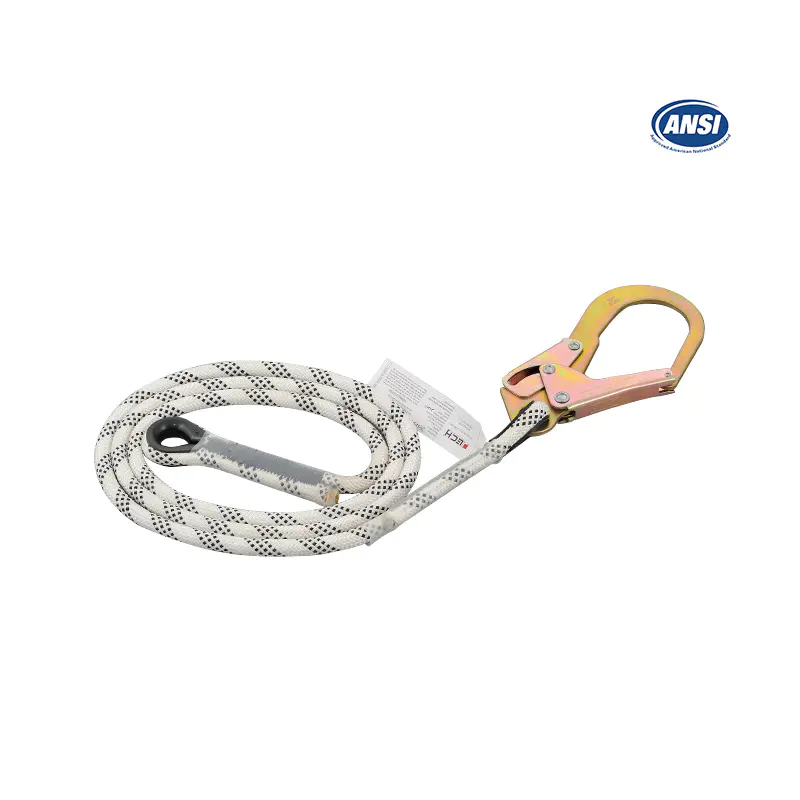
An anchor leads the force of a fall into the building or surface it holds. The Carabiner of a full-body harness clips to the fixture, the connector grips the structure, and the structure takes the load. Because each part passes force to the next, a connector is as useful as the member it surrounds; a strap around a thin flange and a strap around a thick column describe two different situations even when the strap is the same.
The harness end of the connection deserves equal attention. A carabiner gate needs room to open and close, and an end loop that is too small crowds it. Straps and rope connectors are normally finished with loops sized for that gate, so Anchor Devices can be clipped on quickly even with gloved hands, a detail crews notice within the hour on site.
Height changes the picture. An anchor above shoulder level keeps the potential drop short, and one at foot level lengthens it. Product lists for Anchor Devices therefore tend to state the beam width range, column diameter, and rope length each connector suits, since those figures show whether a part fits the structure before it leaves the warehouse.
Lines and Frames for Open Work
Some jobs have no convenient structure overhead. Long flat roofs call for a temporary horizontal lifeline strung between two end anchors, which lets a crew move along an edge without unclipping; JECH lists one as a Type C horizontal anchorage lifeline. Tanks and manholes use a rescue tripod with winch, a free-standing frame that stands over the opening and carries the line from above, and the range includes two versions.
Inquiries from overseas importers often ask about these two items together with strap connectors, since a contractor who needs one frequently asks about the other. For the Anchor Devices that serve open work, the shared point is geometry: a lifeline needs end anchors at the right spacing, and a tripod needs level ground under three legs.
On a sloped roof, the anchor climbs the slope with the crew, and a connector that is quick to fasten and release keeps pace with them. That small movement, repeated across a working day, is where the choice of connector shows up on site.
Your email address will not be published. Required fields are marked *

One-stop work at height solutions
Contact Us
- No.1448 Tongxi Road Linjiang Industrial Zone, Wucheng District, Jinhua city 321025, Zhejiang Province, China
- +86-579-82210589
- jech@jechsafety.com
Subscribe US
Stay updated with our latest news. We promise.