
 English
 عربى
 Español
 Deutsch
Full Safety Harness With Lanyard Balances Support and Energy Absorption

Jinhua JECH Tools Co., Ltd. has specialized in personal protective equipment for high-altitude work for 16 years. As a national standard drafting organization, the company operates a professional product testing center certified to ISO/IEC 17025 (CNAS L20086).
A worker on a roof edge or a telecom tower depends on two pieces of equipment that do different jobs. The harness spreads the force of a fall across the shoulders, chest, and legs. The lanyard connects the harness to a fixed anchor and absorbs part of the energy before the load reaches the body. A Full Safety Harness With Lanyard brings both pieces together, and Jinhua JECH Tools Co., Ltd. in Jinhua, Zhejiang, produces them as a coordinated set.
The Harness Carries the Body
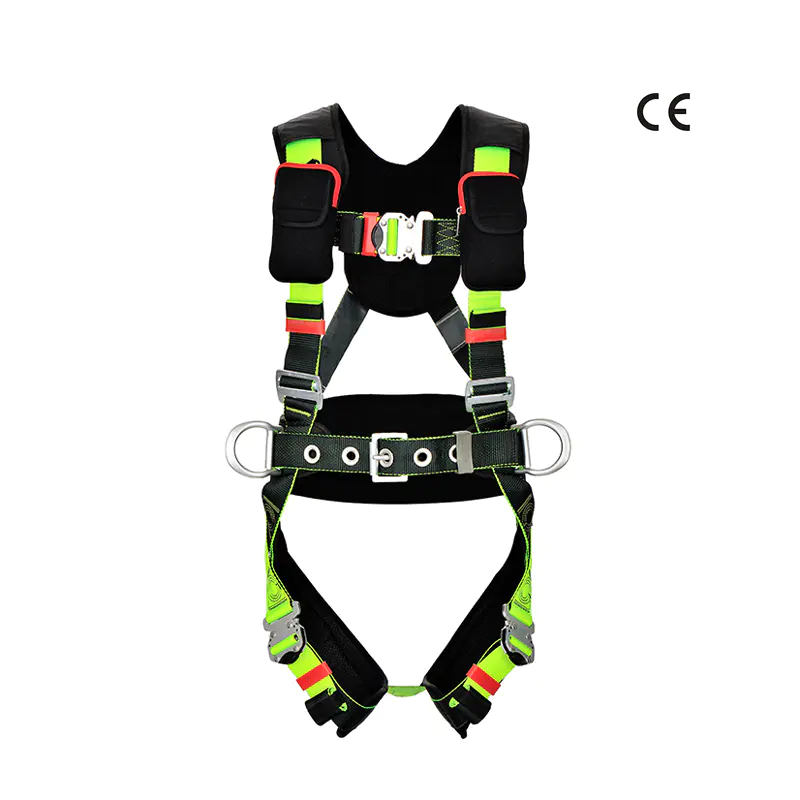
In a Full Safety Harness With Lanyard, the full body harness uses webbing straps that run over both shoulders, around the chest, and under both thighs. If a fall occurs, the straps hold the worker upright and distribute the load across the strongest parts of the body instead of concentrating it at the waist. Jinhua JECH Tools Co., Ltd. makes a wide selection of polyester full body harnesses, including the 100059 and 100047 polyester models, along with construction, climbing, multipurpose, and fall arrest kit versions. The 100070 Full Body Safety Harness with Lanyard sits in the range as a ready-to-use pairing.
The Lanyard Carries the Energy
A lanyard is more than a rope with two hooks. In every Full Safety Harness With Lanyard, a shock absorber is built into the lanyard, usually as a folded section of webbing stitched with tear-away threads. When a fall loads the lanyard, the stitching tears in sequence and the webbing unfolds, which slows the stop and lowers the force on the body, so the shock absorber carries the peak load before it reaches the worker. Jinhua JECH Tools Co., Ltd. makes three lanyard types: the Single Shock Absorber Lanyard, the Twin Shock Absorber Lanyard, and the Work Position Restraint Lanyard. Each type matches a different kind of task, and a Full Safety Harness With Lanyard can be configured around the one the job requires.
Single, Twin, and Restraint Lanyards
A single lanyard suits work in a fixed location, where the user clips to one anchor and stays put. A twin lanyard gives continuous protection while moving, because each leg carries its own shock absorber and one stays connected while the other moves to the next anchor, and that arrangement is common on steel structures and scaffolds. A work position restraint lanyard serves a different purpose. It holds the worker at a position, such as a roof edge, so that a fall cannot occur at all. Offering all three lets a Full Safety Harness With Lanyard order cover roofers, riggers, tower crews, and maintenance staff from a single supplier.
Standards Behind the Equipment
Safety equipment earns trust through testing, and each part of the system has its own standard. Full body harnesses are tested to EN361, connectors to EN362, lanyards to EN354, energy absorbers to EN355, guided fall arresters to EN353-2, work positioning to EN358, sit harnesses to EN813, rescue harnesses to EN1497, and climbing harnesses to EN12277. In the United States, ANSI Z359.12 through Z359.15 apply. One Full Safety Harness With Lanyard can be documented to the standard of its destination.
CE and ANSI Versions
The harness range divides into CE and ANSI categories, reflecting the two main regulatory systems. The 100119 CE Full Body Safety Harness and the 100013 CE Multipurpose Full Body Safety Harness follow the European approach, while the ANSI category serves the American market. The factory can supply a Full Safety Harness With Lanyard to either system, and a Full Safety Harness With Lanyard for the American market is documented to ANSI while one for Europe is documented to EN.
Consistent Production Across a Batch
A harness is stitched, not welded, and stitching quality shows in the seams. Operators sew load-bearing joints with a defined stitch pattern and thread type, and inspectors check each joint for skipped stitches and loose ends. Hardware such as buckles and D-rings is matched to the webbing so that the strap passes through without distortion. Jinhua JECH Tools Co., Ltd. offers its own D-rings and connectors alongside harnesses, so the hardware and webbing come from one coordinated source. That coordination helps a Full Safety Harness With Lanyard arrive as a single, matched assembly.
Your email address will not be published. Required fields are marked *

One-stop work at height solutions
Contact Us
- No.1448 Tongxi Road Linjiang Industrial Zone, Wucheng District, Jinhua city 321025, Zhejiang Province, China
- +86-579-82210589
- jech@jechsafety.com
Subscribe US
Stay updated with our latest news. We promise.