 English
 عربى
 Español
 Deutsch
Mountaineering Equipment Harness Configurations Differ by Attachment Points

Jinhua JECH Tools Co., Ltd. has specialized in personal protective equipment for high-altitude work for 16 years. As a national standard drafting organization, the company operates a professional product testing center certified to ISO/IEC 17025 (CNAS L20086).
A Mountaineering Equipment Harness is defined by more than its webbing and overall shape. The number and position of attachment points, adjustment structure, back support components, and hardware arrangement all influence how an individual model is configured. For distributors sourcing mountaineering and height-safety equipment, these structural differences help distinguish products that may appear similar in a catalogue.
The JECH safety harness range includes models listed under mountaineering equipment and outdoor climbing product names, as well as multipurpose full-body harnesses. Some models share a 45 mm high-strength polyester webbing construction but have different attachment layouts and stated applications. These details are central to comparing each model.
Attachment Points Define Different Harness Functions
Attachment point placement is one of the main differences between full body harness configurations. JECH model 100029, listed as an Outdoor Rock Mountain Climbing Safety Harness, includes one dorsal D-ring, one frontal D-ring, and two hip D-rings. The dorsal attachment is specified for fall arrest, while the hip D-rings are listed for work positioning and travel restraint.
Model 100018 also includes a dorsal D-ring, a frontal D-ring, and two hip D-rings. Its product description identifies the dorsal and frontal attachment options for fall arrest, rescue, and travel restraint, while the hip attachment points are specified for work positioning and travel restraint.
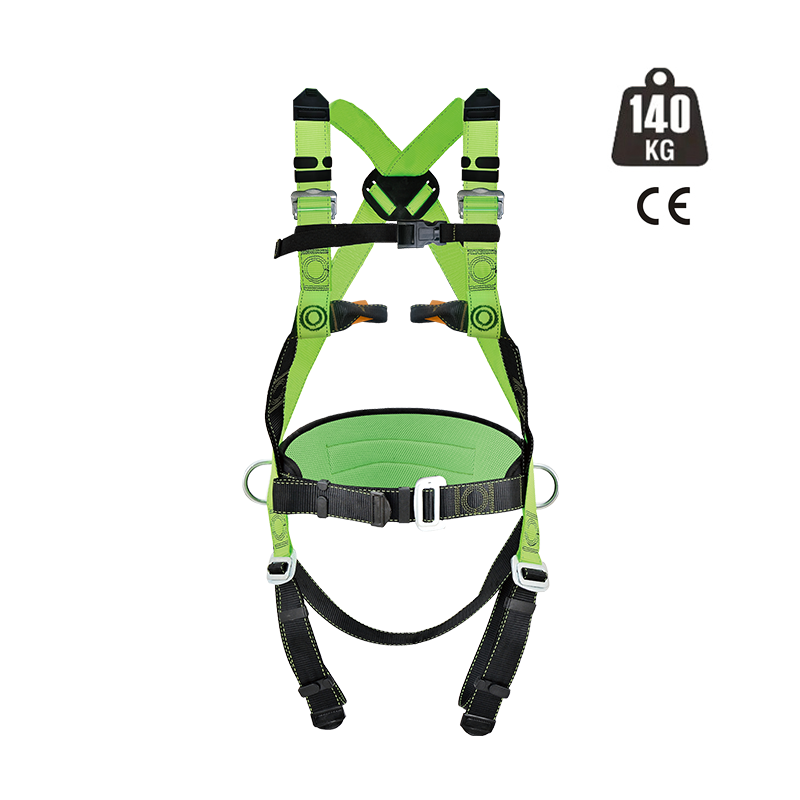
These arrangements provide different connection options within the same general product category. When evaluating a Mountaineering Equipment Harness, the position and stated function of each attachment point are more informative than simply counting the metal rings.
Webbing Construction and Strength Specifications
Both models 100029 and 100018 list 45 mm high-strength polyester webbing. Their product information also specifies a mini breaking strength of 5,000 pounds. This shared construction provides a useful example of how two harness models can have similar basic webbing specifications while differing in other structural details.
The webbing is part of the complete harness assembly, which also includes attachment hardware, adjustment straps, and supporting components. Material width and stated strength are useful specifications, but they should be considered alongside the complete model configuration of a Mountaineering Equipment Harness.
JECH also lists customizable color options for model 100029, with yellow and black shown in its product information. This provides an additional product variation within the range.
Adjustment Structures Differ Between Models
Adjustment points help accommodate different body dimensions and allow the harness straps to be fitted according to the manufacturer's instructions. The 100029 model lists four adjustable points across the shoulder and thigh straps. Its structure also includes two webbing loops on the shoulder straps.
Model 100018 lists adjustable chest, shoulder, and thigh straps. These details show that adjustment arrangements are not identical across the range. The specific strap layout should therefore be considered when comparing one Mountaineering Equipment Harness with another.
For product selection, the adjustment structure is closely related to the harness's overall configuration. It should be reviewed together with the attachment layout and the manufacturer's fitting instructions rather than treated as an isolated feature.
Back Plates and Sit Straps Add Structural Differences
The back plate and sit strap are two additional components found in the listed JECH models. Model 100029 features a high-resistance polyethylene back plate and an ideally positioned sit strap. Model 100018 also lists a specially designed polyethylene back plate and a sit strap intended to support the harness structure.
These components distinguish the models from simpler harness configurations that may have fewer supporting elements. The back plate is part of the rear attachment area, while the sit strap is included as part of the body-supporting structure.
For buyers reviewing a Mountaineering Equipment Harness product range, these details help explain why harnesses with similar webbing dimensions can still have different construction arrangements.
Product Applications and Standards Are Model-Specific
The stated applications also differ between product listings. Model 100029 is listed for construction and maintenance, free fall arrest, elevated work platforms, and work positioning. Model 100018 lists construction and maintenance, free fall arrest, and elevated work platforms.
Both product pages list ANSI Z359.11-2014 and a mini breaking strength of 5,000 pounds. These specifications belong to the respective model listings and should be presented with their corresponding product identification.
Although some JECH product names include mountaineering or climbing terminology, the detailed specifications for these two models describe multipurpose full-body safety harnesses. They should not automatically be treated as interchangeable with sit harnesses developed specifically for sport climbing. This distinction is important when sourcing a Mountaineering Equipment Harness for a defined application.
Comparing Harness Models Through Their Construction
The 100029 and 100018 models illustrate how attachment points, strap adjustment, back plate construction, and stated applications contribute to the differences between full body harness configurations. Both use 45 mm high-strength polyester webbing and list a mini breaking strength of 5,000 pounds, yet their product descriptions identify different adjustment arrangements and application details.
For distributors and equipment brands, these model-level characteristics provide a clearer understanding of the JECH Mountaineering Equipment Harness range. Comparing the complete construction and the stated application of each model helps keep product descriptions accurate and makes the differences between individual harness configurations easier to understand.
Your email address will not be published. Required fields are marked *

One-stop work at height solutions
Contact Us
- No.1448 Tongxi Road Linjiang Industrial Zone, Wucheng District, Jinhua city 321025, Zhejiang Province, China
- +86-579-82210589
- jech@jechsafety.com
Subscribe US
Stay updated with our latest news. We promise.